
Flowers and the War Fields
It is a paradox. They’re total contrasts in nature. Yet, they coexist.

For someone who got introduced to rock music at an early age (thanks to my uncles & cousins), the name of the band Guns and Roses seemed peculiarly cool. This was way before I knew about oxymorons or paradoxes. While the story behind the origin of the band’s name goes back to its initial band members’ names, I always thought this had something to do with their songs revolving around love, sex, violence and drugs. However, this post won’t deal with any of their songs. Now, let’s circle back to this post’s title – Flowers and the War Fields. Such contrasts, yet they can co-exist.
Two Sides of the Same Coin – Destruction and Creation
Except for reading them in books or watching them in movies, I’m guessing many who are reading this may not have witnessed a war field. And if you were ever unfortunate to have passed through one, I cannot imagine what you may have experienced. That said, the flowers on a war field are like the rarest combinations, perhaps? You see life and death, flourish on the same breath. Now if we were to delve deeper into these killing machines, I’m reminded of this song from The Sound of Music – Edelweiss. The song is based on the rare Edelweiss flower that is found at a higher altitude in the alps. And the flower symbolizes bravery, strength and endurance for its grit to survive on such a terrain. While this song appears twice in the movie – the first time when the Lead character, Captain Van Trapp sings a duet with his daughter, when he senses music returning to his life after his wife’s passing. Then there is the second time, which hits harder, when he sings to convey a silent rebellion against the Nazi invasion. Perhaps, I won’t spoil this for you if you haven’t watched the movie. So please do watch it. And for those who have, you know what I’m talking about. Moreover, this song is a somber goodbye set to tune by Oscar Hammerstein II and Richard Rodgers. In fact, a metaphorical and a literal goodbye as it was the last song the duo wrote, before Hammerstein’s death. And what a song?! Give it a listen when you really have a few minutes to spare. Please.
Same Message — Decades and Destinations Apart.
Decades and frontiers apart, a similar message was floated in a song, from a movie made in South India. The plot of the movie, based on a true story, revolves around a little girl, going in search of her mother, who was a Sri Lankan refugee. To add some drama to this, the 9-year-old daughter shuns the adopted mother who raised her – set out on a quest in search of the mother who gave her birth but abandoned her. The whole premise of the story elevates when her adopted parents join this quest and visit Sri Lanka to discover that the mother’s identity has changed to someone who isn’t a refugee. Well, as usual, I won’t spoil this for you. If you haven’t watched this movie, I highly recommend you do. Without digressing much I will get straight to the song- Vellai Pookal from Kannathil Mutthamittal.
If I remember correctly, the song plays at the beginning and towards the end of the movie. Not a complete song, but more like a soundtrack in the background. And to draw a parallel, you could compare it to – John Lennon’s Imagine. The song begins with a gentle strum of a guitar and sustains throughout. Complemented by the fragile voice of AR Rahman with multi track backing vocals, subtle bass and some keyboards to fill in, it could be classified as a ballad. Only towards the middle can one hear the cymbals chiming followed by a soft drumroll. Also, the flute manages to elevate the listener higher up as they mindfully listen. Without exaggeration, listen to this song with both eyes closed as you lean back – you’ll know what the song conveys. Perhaps, if need be, you could always look up the lyrics and the meaning. But the song is a prayer or a plea. And this plea uses words to reiterate the message. Also, somewhere back in my head this song resonates whenever I read or chance upon some news about wars being fought.
The Irony of War History – It repeats itself.
We have read about it, as mentioned earlier, maybe we’ve been caught amid a war. But we rarely learn from it, and neither do the so-called leaders. Afterall, they’re not the ones on the frontline. Case-in-point, this painting from Ronald Francis, who paints in Trompe-l’œil (French for “deceive the eye”) style. A style of painting that’s goes over the head for the break-neck generation like us, since we will casually scroll past. In fact, this is where the need for galleries is more significant in these times than ever. We’re slowly losing out the ability to see. So, we need a purpose and a place to sit down, observe and read between the lines.
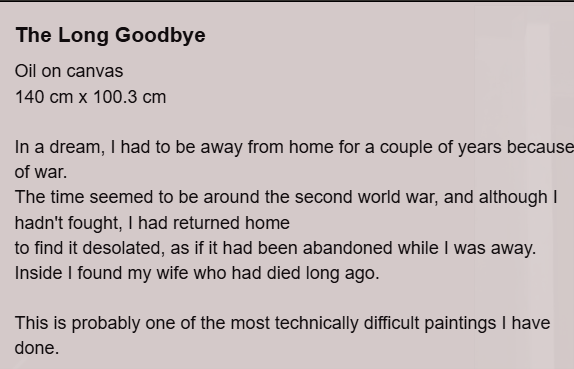
Now, may I request you to look at this painting a bit closer. The painting is based on a dream the artist had. Perhaps you could read the text about it a bit later, to avoid any spoilers. Let’s see what we gather from the viewing first.
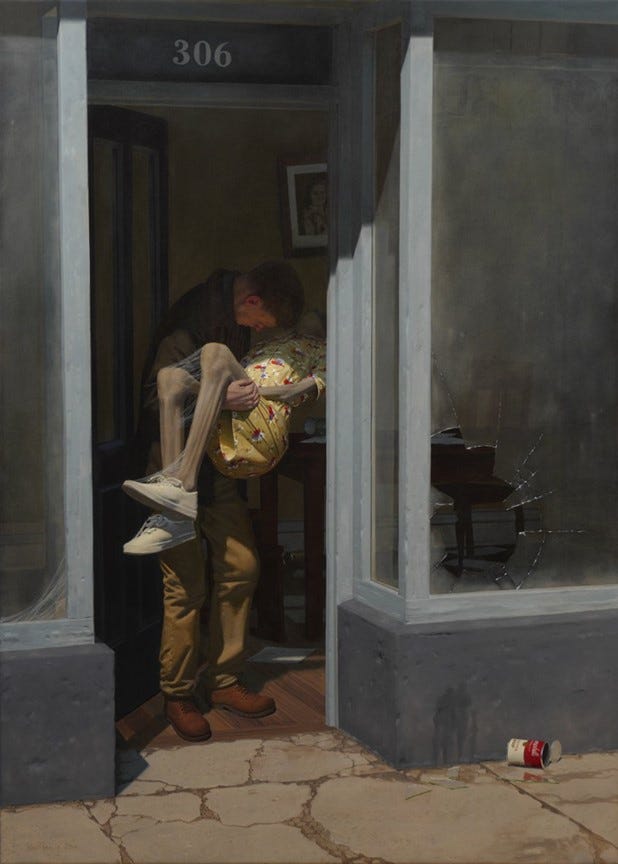
At first glance, you see a man carrying someone out of the door. You scroll past and you’ll miss the whole story. Now, look at the picture again. Look closely. You’ll see the man is a soldier and the one he’s carrying could be his fiancé or wife. And when you see her, you see it’s probably a deceased body as the flesh has blackened and the arm and legs are bony. In the background, is a partly visible tilted portrait of the soldier. Could be his wedding portrait. In the foreground you see cobwebs on the left windowpane and the right window pane is broken. The opened can’s reflection could be seen on the broken glass on the floor. Perhaps, someone tried to break the glass with it and gain entry. And the stain by the door seems like a dog or some kid might have relived themselves. Now, you can read the caption – the artist wrote for the painting.
An Open Ended Conclusion
Truth be told, the effects of war isn’t just reserved to those who are at the frontline. The ripple effect touches every single person alive at some point and at some part of this earth. And, the recent times are an evidence to this, however, one can hope for the white flowers to bloom. Also, as uncertain is the plight of war — how war is a vulgar display of a human invention that at some point is waged to find peace — the irony is unmissable too. Finally, one confession, akin to how one seldom knows when and how a war ends — this post too ends abruptly.
PS: However, I will leave you with this poem:
Wage Peace
By Judyth Hill
Wage peace with your breath.
Breathe in firemen and rubble,
breathe out whole buildings
and flocks of redwing blackbirds.
Breathe in terrorists and breathe out sleeping children
and freshly mown fields.
Breathe in confusion and breathe out maple trees.
Breathe in the fallen
and breathe out lifelong friendships intact.
Wage peace with your listening:
hearing sirens, pray loud.
Remember your tools:
flower seeds, clothes pins, clean rivers.
Make soup.
Play music, learn the word for thank you in three languages.
Learn to knit, and make a hat.
Think of chaos as dancing raspberries,
imagine grief as the outbreath of beauty
or the gesture of fish.
Swim for the other side.
Wage peace.
Never has the world seemed so fresh and precious.
have a cup of tea and rejoice.
Act as if armistice has already arrived.
Celebrate today.
#acnotes
Beautiful poem