
Press 'Skip Intro' and you could Miss the World’s Shortest Love Story
This is a story of boy meets girl. Period.

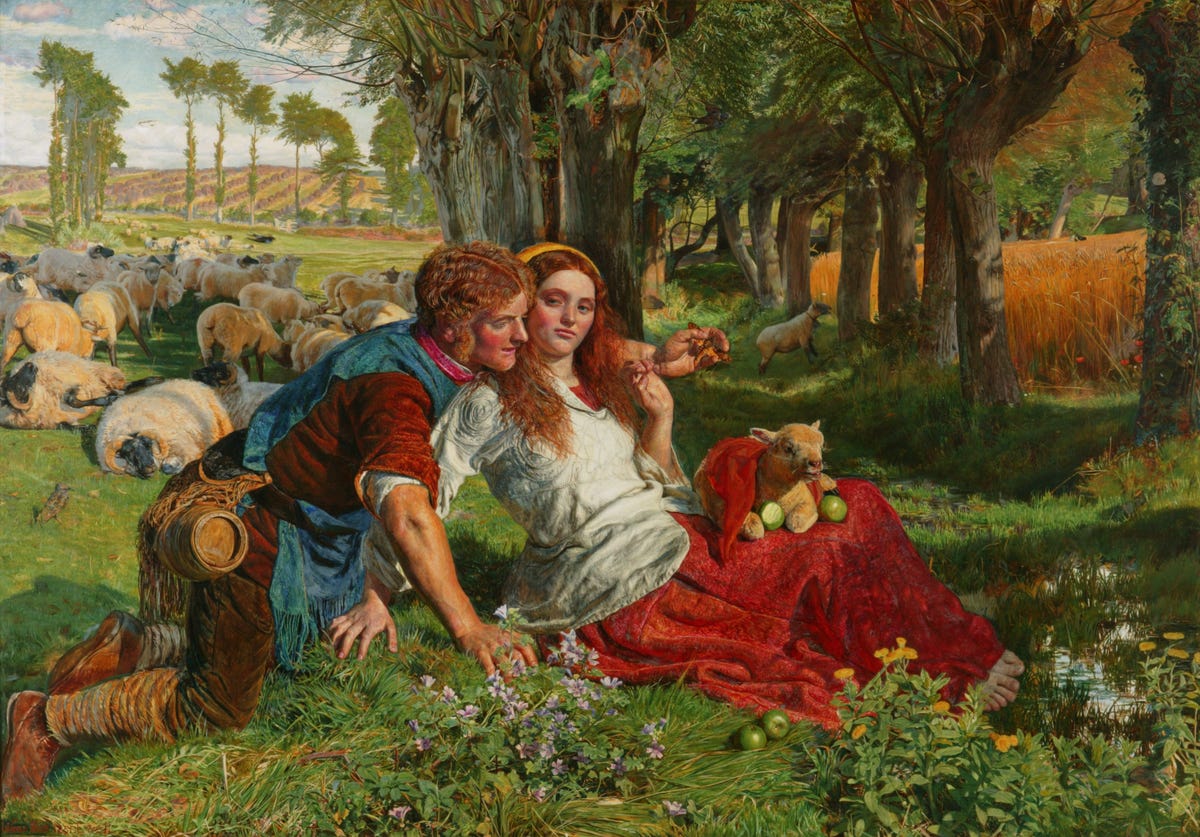
A slight digression from the main plot to share a striking parallel between the painting you see above and the story about this brief song I will be sharing with you in a moment. The Hireling Shepherd (1851) is a painting by the Pre-Raphaelite artist William Holman Hunt. It represents a shepherd neglecting his flock in favour of an attractive country girl to whom he shows a death's-head hawkmoth. The meaning of the image has been much debated (Source: Wikipedia). One of the interpretations of this painting is about how the shepherd has forgotten or has ignored what he ought to do and is besotted by the charm of the girl he’s trying to woo. As you read on, you may find a similarity with the protagonist we are about to meet. And the rest, I will leave it at your discretion to decipher.
Now, pretend you didn’t read what you just read and let’s begin with a blank slate.
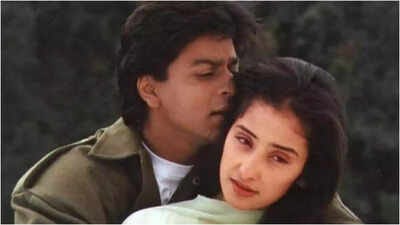
||A traveler, a stormy dark night, a railway station at some distant land, a stranger on a bench wrapped up in a blanket and a train that’s behind schedule. Could the sum of all these elements lead to a story? Well, with Mani Ratnam and AR Rahman it certainly does. And when it’s through the eyes of Santosh Sivan, the experience gets even more immersive. Now imagine you’re there, on the left- a traveler with an Id card dangling from his neck and lugging some baggage walks onto a platform. A few feet away, a stranger bundled in a blanket is seated on a bench. The traveler mistakes the stranger for a man, asks him for a match to light his cigarette. And then a gust of wind enters the scene to reveal, it’s a girl. There’s a brief exchange of glances and words. Truth be told, it’s the male protagonist who does most of the chatter while the female protagonist first seldom responds and then smiles, follows it up with a request – “A hot cup of tea”. A request or a distraction to get rid of him. No spoiler here, the very next scene reveals that by the time he returns, she has boarded the train. And he sees her leave as it rains. He let’s out a loud call “Oy!”. She quickly looks back. Their eyes meet, but the train parts them, as though it was delayed on purpose to do just this. He mumbles to himself “This is perhaps world’s shortest love story.”||
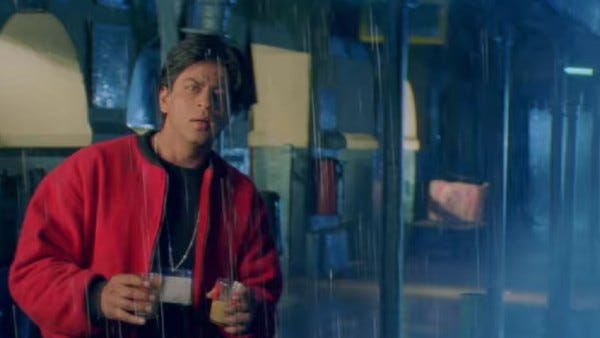
For some visual relief, you could watch either of the versions depending on the time available to you:
Hindi
or Tamil
In a time and age, where the viewer has been given the option of skipping the intro, here the introduction itself is a short film. And then what follows is its sequel. Rather, a musical sequel. The consequences of this brief encounter and how the male protagonist passes through 7 shades of love (attraction, infatuation, love, reverence, worship, obsession and death). Enough has been said about this already and its songs on the album. If you’re not too familiar, do look it up. This post is mostly about the first scene and a tiny song that repeatedly plays in the background whenever both the protagonists meet unexpectedly. In the original album, it’s titled as Main theme. Sharing both the Hindi and the Tamil versions below.
Hindi:
Tamil:
The two lines that play on loop are from a poem by the late Allama Iqbal:
“Sitaaron se aage jahaan aur bhi hai”
Beyond the stars, there are many more worlds/universes.
“Abhi ishq ke imtihaan aur bhi hain”
And in love there are more tests/trials of love".
Also, another rendition of the poem as a ghazal. Clearly, rendered in a truly contrasting style.
Trivia: The first line of this poem was quoted in a conversation between the Late Indian-born Astronaut Kalpana Chawla and Former PM of India - I.K. Gujral.
While there’s more to this ghazal/ poem, only the first two verses/lines were picked. And the same was also translated to Tamil. Perhaps, this is to prepare the audience for what’s to come. And one truly needs to read between the lines to understand where the story is heading.
Furthermore, there’s one line that came at the top of my mind when I watched Dil se… once again, few weeks back. And it’s a line from 500 Days of Summer.
“This is a story of boy meets girl. But you should know up front, this is not a love story.”

To close, here’s a Rumi’s poem* (I don’t subscribe to this translation though, go to the end to find out) that could allude to what was shared before.
Out Beyond Ideas of Wrongdoing and Rightdoing
Out beyond ideas of wrongdoing and rightdoing,
There is a field. I’ll meet you there.
When the soul lies down in that grass,
The world is too full to talk about.
Ideas, language, even the phrase each other
Doesn’t make any sense.
Translated from Persian by Coleman Barks and John Moyne, from The Essential Rumi, published by HarperCollins. Copyright © 1995 by Coleman Barks.
For those who have already watched the movie, you might already know both the lead characters are led by two separate identities and ideologies. While one is trying their best to drag the other onto their side, it’s a pursuit of futility. And love in this story especially is a mere façade to show the true state of the nation. Now to connect the two lines to the story, the song throws in cues about how theirs is a love that could have survived in parallel universes, except for this one. Also, there will be many tests in this pursuit for love. That said, the end of the movie is left for the audience to decide - did both the protagonists win their tests in their own way or was it a game that ended as zero-sum?

*Rumi’s Poem – The Erasure of Islam from the Poetry of Rumi
#acnotes
I have got an urge to listen to these songs now! Wonderfully written 🙌
So beautifully recreated Amit. This scene is truly a gist of the entire story. I also loved the Rumi references especially since I am re-reading 40 Rules of Love by Elif Shafak right now.